PISA errors were 'serious and unacceptable', Catalan president says
Salvador Illa says failures in interpretation, oversight and information-sharing allowed proportion of excluded pupils to rise to 23.2%, well above OECD's 5% threshold
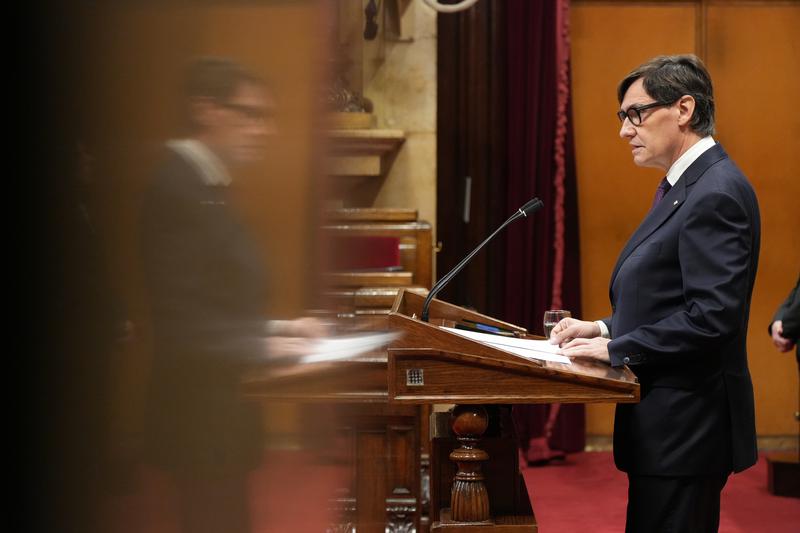

Catalan President Salvador Illa has acknowledged that "serious and unacceptable" errors occurred during the 2025 PISA tests, while defending the government's efforts to identify what went wrong, establish responsibility where appropriate and prevent a recurrence.
In an appearance before Parliament to explain the PISA testing error, Illa said an investigation launched after the government learned of the problems had identified "errors of interpretation, oversight and unacceptable shortcomings in the transmission of information within the organisation."
He said Catalonia's Higher Assessment Council had information about the issue but did not pass it on to the education minister or the department's other political leaders.
Illa said the government "does not want to minimise" what happened, describing it as a "serious error" in the process of applying, monitoring and validating the sample.
The government's responsibility, he said, was to explain what happened, establish accountability and correct whatever had failed.
What went wrong?
Illa laid out a chronology of events broadly in line with the account given by Education Minister Esther Niubó in late August, explaining that at the time of the tests, responsibility lay with the Higher Assessment Council.
On March 11, 2025, before testing began, the body held an in-person briefing for the selected schools and provided them with documentation containing information supplied by Spain's National Institute for Educational Evaluation (INE).
Illa said the information was "correct but incomplete," because it did not include the 5% maximum threshold set by the OECD for excluding pupils from the PISA sample.
Testing began on March 31 and ended on May 16. On May 9, what Illa called the "first turning point" occurred when the INE told the Assessment Council that the percentage of excluded pupils was exceeding the limit and asked it to remind schools of the established maximum.
Illa said the investigation "has not been able to establish" that the warning reached the schools. "There was still room to act," he said.
The president said the Assessment Council received "up to six technical reports" about the issue.
He therefore argued that monitoring "could and should have been" strengthened, that schools where the tests had not been carried out should have been warned, and that oversight of exemptions within the sample should have been tightened.
He acknowledged that the appropriate corrective action was not taken.
The final technical report addressed to the Assessment Council was dated May 30, Illa said. From that point, "communications about this incident stopped, or at least there is no record of them."
He said information existed "for months" without reaching the appropriate decision-making levels.
In February 2026, the current director of the Agency for Assessment and Foresight received information "orally" about the incident.
It was then, Illa said, that the matter began to be escalated within the Education Department, leading to the opening of an investigation.
In June this year, the INE informed the agency of the scale of the problem: 23.2% of pupils had been excluded, compared with the recommended threshold of 5%.
Dismissal
The episode led to three disciplinary proceedings and the dismissal of Teresa Sambola as secretary-general of the Education Deparment.
Despite the error, Illa said the overall PISA results, particularly those for Spain, provide useful information and point to a "very worrying" decline in performance. He said this should serve as a stimulus to take action to improve results.
He reiterated the government's commitment to working towards spending 6% of GDP on education, while acknowledging that this would have to happen "gradually" and without setting a timetable. "Gradual does not mean slow," he added.
Sharp criticism
Illa's admission of "serious and unacceptable" errors in the 2025 PISA tests drew sharp criticism from across the political spectrum in Parliament, with Junts accusing the government of concealing the problem and again calling for Education Minister Esther Niubó to resign.
ERC also condemned what it described as a lack of transparency in the government's handling of the affair, while Comuns said a proposed education pact could not be used as an excuse to shield Niubó from political responsibility.
The PPC, Vox, CUP and Aliança Catalana also attacked Illa over the handling of the PISA tests.