Catalonia's oldest man turns 110: 'I played football in the middle of Gran Via, a car would pass every 20 minutes'
Joan Escudé still cooks at home, forages for mushrooms, and remembers his years as a Republican soldier in the Civil War
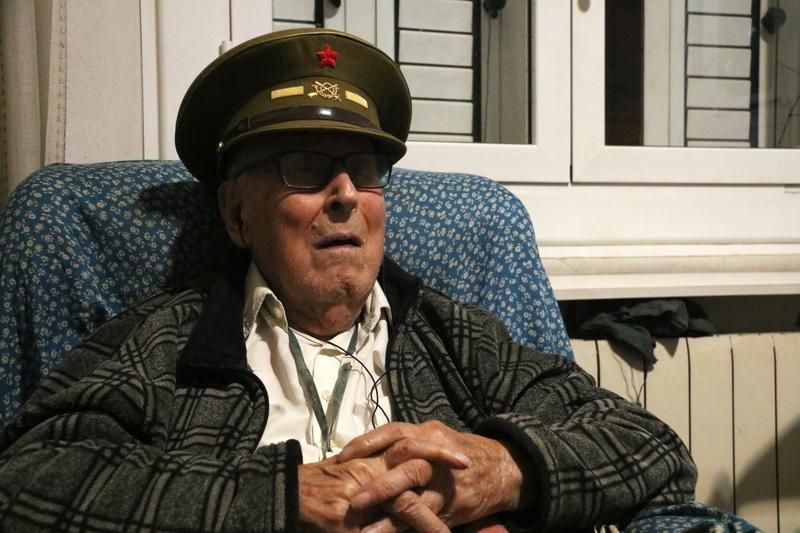

On January 6, 1916, in the midst of World War I, the current oldest man in Catalonia, Joan Escudé, was born in Capellades. This Tuesday, he turns 110 years old.
He's reached this age with a lucidity and memory that let him recall Barcelona in the 1920s, when he "played football in the middle of Gran Via," where "a car would pass every 15 or 20 minutes."
He is also able to recount with precision his years as a Republican soldier in the Civil War.
In an interview with the Catalan News Agency from his home, where he lives with one of his two children, he explains that he's still more than capable of looking for mushrooms, making his bed, and preparing his own lunch. "I try to cause as little inconvenience as possible," he says.
Escudé is among the twenty oldest people in Spain, and is younger than the oldest Catalan, the 111-year-old Carme Noguera. He is only three years behind the current oldest man in the world, and six years behind the person who has lived the longest in history, according to the Gerontology Research Group (GRG) association.
Second Republic
Escudé remembers parts of his childhood around 1923 and 1924 in Capellades. Specifically, he recalls "the day they changed the wooden cutlery at home to iron ones," including forks and spoons.
He also remembers "when they put water in the houses" in the village, and it was no longer necessary to go to the spring to get it, or "when the electricity came" to the municipality.
When he arrived in Barcelona, he can remember when there were practically no vehicles on Gran Via and young people like him could freely play on what is now one of the city's busiest streets.
Back then, a vehicle passed by every 15-20 minutes. Today, some 2,000 pass every hour.
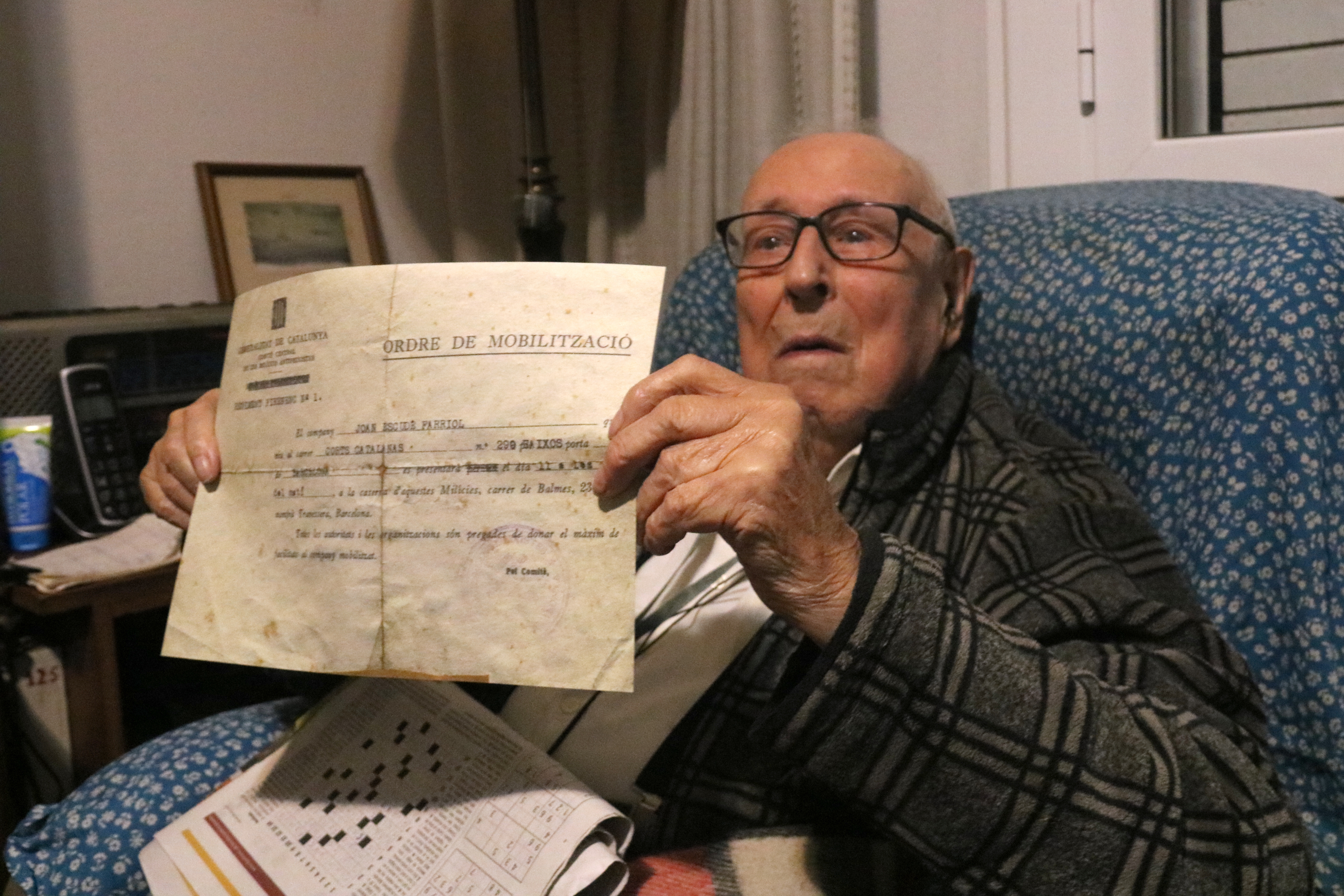
On April 14, 1931, when he was 15 years old, the Second Republic was proclaimed with "a lot of joy." He says there were no shots fired and people seemed "satisfied." In an interview with Catalan News in 2021, on the occasion of the 90th anniversary of the event, he added that "the fact that there was a certain freedom was a relief."
The young man ended up working for a company repairing Parker fountain pens, which was cut short in 1936, with the outbreak of the Civil War. "I wasn't aware that it was serious, at first," he recalls of the military insurrection of July of that year.
After the outbreak of war, the Catalan government launched its first military unit since 1714, the Pyrenean Regiment. Escudé enlisted, as he had always "liked the mountains a lot and the battalion was ready to go to the Pyrenees."
"I went from trench to trench, going through some attacks and counterattacks, saving my skin," until the Aragonese front fell in the spring of 1938, and his division was surrounded by Franco's forces.
"We were locked in there, and we held out as long as we could, because we didn't even have cannons, only hand grenades and rifles," he recalls, "but the terrain was favorable to us, and we held out from March to June."
Republican fighters, such as Joan Escudé, were able to flee to France, which was interpreted as a success.
Post-war difficulties
After the war and after returning to Catalonia, Escudé had difficulties in finding work since the company that repaired Parker pens did not want to reinstate him because "they were Italian fascists" and disapproved of his background as a Republican fighter.
Through a relative, he ended up working as a salesman in a paper craft workshop, and with his new income, he was able to get married and have children in the 1950s.
After setting up his own paper craft workshop, he had a pension after retirement, which, combined with some family inheritance, afforded some financial stability that he never enjoyed when he was young.
Escudé, now a widower, still travels to Montseny every Thursday to have lunch with his family. He looks for mushrooms in the same massif when in season, although he admits that he can no longer bend down to pick them due to his reduced mobility.