How bots dominate the immigration appointment system and why it isn't getting fixed
Cybersecurity experts warn that preventive measures against bots would be relatively easy to implement but costly
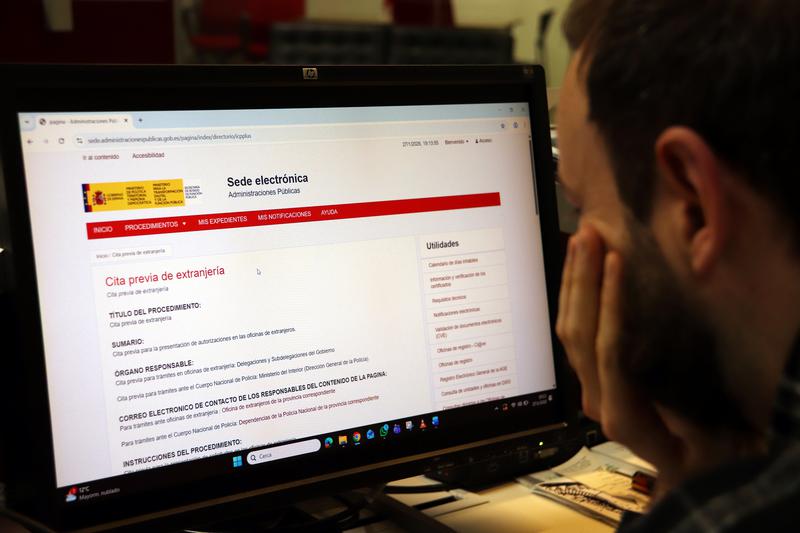

A few minutes before 3pm on a Thursday, you settle in with your computer, phone, and every device at hand. This is the moment when appointments are released, the moment you’ve been waiting for to finally secure the NIE or TIE appointment you’ve been chasing for weeks.
The time arrives. Everything is ready; but there are no appointments. The website times out, or an error message appears. The opportunity is gone. You’ll have to try again next Thursday, since no new slots will be made available until then.
This is the unfortunate reality that, for the past few years, many people trying to get appointments with immigration services in Catalonia have faced, with many resorting to the black market to buy appointments.
Behind the completely blocked website is an enemy that is almost impossible to beat: bots. "It will always be faster than a human," explains René Serral, a UPC professor and researcher at inLAB FIB.
"The bot does not need to move the mouse, fill in the fields, and then submit the form. Instead, it sends the entire data package directly, and it can do this repeatedly," he explains.
According to the expert, it is not necessary to be an expert to build one of these bots, especially for the appointment website, which in many applications does not have enough identity verification. With AI, the process has become even easier.
"The website is stable, it never changes, so the bot can improve and find ways to penetrate it and bypass whatever protections it has," he explains.
However, bots are not impossible to beat, and there are many preventive mechanisms that most websites implement today to stop them.
"CAPTCHA is the easiest and most common one, those little puzzles that make you drag a piece to the right place, and some systems can also detect bots because they act too quickly," he explains.
Implementing them would not be difficult, he says. "They are already made; you just have to plug them in. The problem is that for some websites, adding them means changing the workflow they already have in place, which involves an additional cost they are not willing to assume."
In the end, he says, it depends on whether they see it as a problem or not.

Natalia Caicedo, a constitutional law professor at the University of Barcelona (UB), believes the reason these measures are not implemented is economic.
"The administration contracts a third company to provide the appointment service. They issue a public tender, and within the tender conditions they could clearly require controls to prevent the use of bots, but they do not do so. Why? Because economic criteria are given priority," she says.
The expert, who has long studied migration processes and the administration, believes a service like the one provided for migration would be "unthinkable" in any other public service.
"If we look at healthcare or education, it is very easy to obtain an appointment: the steps to follow and the deadlines are clearly established. But this does not happen with migration procedures. Instead, the approach is to control and make access more difficult," she says.
On top of this, guidelines are very difficult to follow, and it is sometimes especially hard given that migrants who have just arrived in the country are the ones using this service and often do not speak the language.
"Everything is in Spanish, and the vocabulary is very technical. It is a literal reproduction of the legislation and regulations, which makes it obvious that you need a lawyer to understand it. There is no translation to help citizens understand it," she says.
At the heart of it, she believes, there is "institutional racism," because the administration has the tools to improve the service, "but actively decides not to."
"There is the idea that migrants, when they arrive, need to face many difficulties. It is like a kind of toll they have to pay to reach the same position as nationals. They cannot have it easier, especially because of this collective image that people come here to use resources," she says.