Ubiquity of addiction, post-culture society, and the musicality of Irvine Welsh’s singular literary voice
Scottish author speaks about romance and drugs as subject matter, and his latest book, 'Men in Love', the immediate sequel to 'Trainspotting'


Trainspotting author Irvine Welsh believes we’re headed for a post-culture society, in which addiction is ubiquitous, but in which street drugs – a subject matter he’s intimately associated with through unsparing, gritty depictions of heroin use in his books – play only a small role in the plethora of addictions that modern life offers.
Yet, he also predicts a “community-based” societal reaction against social media usage that he classifies as “self-made manacles” that operate as a “control mechanism.”
The globally acclaimed author also links his unique writing style to the rhythms of 4-to-the-floor rave beats and ancient Celtic storytelling traditions.
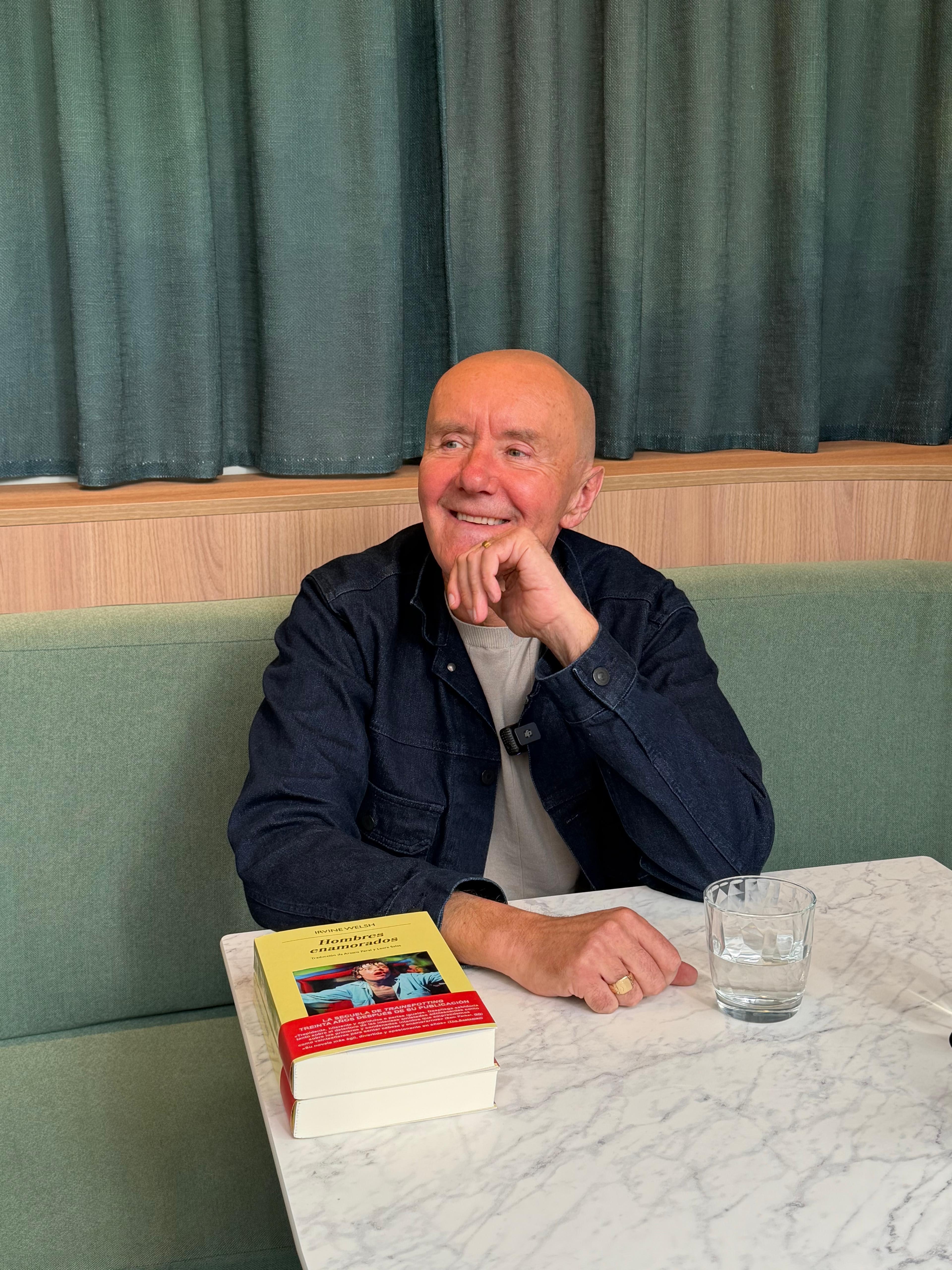
In an interview with Catalan News held ahead of his talk and performance at Brit Under Fest in Poble Espanyol on Saturday, the Scottish author also explained that he still finds creative energy from drugs as a subject matter due to their “ubiquity” in life and pondered the changing face of addiction in modern times.
With his new book, Men in Love, recently published in Spanish by Anagrama, he delves back into the Trainspotting universe, picking up the story immediately after where his debut novel leaves off.
Ubiquity of addiction
When asked what about drugs keeps the subject matter so creatively alive for him more than three decades on from Trainspotting, Welsh pointed to the drugs themselves, and the ubiquity of addiction in the modern world.
He’s also driven to write by the idea that street drugs now are just a “very small part” of modern addiction, pointing instead at internet addiction primarily. “The big tech guys won't let their kids have them, but we can have them and we're encouraged to have them.”
“The whole of society is founded on hypocrisy because the mechanisms of technology are still profit, wealth accumulation, greed. Not wealth accumulation to kind of expand an economy and to educate and to improve people's health and to improve their well-being. It's just a mechanism for personal consumption and avarice.”
Post-culture society and existential angst
The writer offers a bleak assessment of the health of culture currently, positing that we’re headed for a “post-culture society,” mainly driven by the internet, which he says was supposed to be a “bastion of freedom,” but has instead turned out to be “something very confining.”
He predicts a “reaction” against this contemporary mobile phone addiction, citing declining social media usage. “People are going to start to use the phone more judiciously, but I think there will also be a sort of rebellion against the big tech corporations in their manifestations of the internet.”
When asked about how he imagines that will look, he points to “local communities, local democracies, local authorities starting to develop their own cloud capital, starting to develop their own internet systems and platforms and all that to serve their communities.”
He assesses that social life has moved “from street to screen,” and that this has resulted in “less danger on the streets, but more moral panic about it when things do happen.” Yet the cost of this shift has been “a massive mental health epidemic” because of excessive mobile phone use.
“We're like polar bears in the zoo just kind of pacing back and forward looking for dopamine hits.”
In a contemporary global context of artificial intelligence threatening people’s jobs at a scale never before seen, he feels that the sensation of existential angst is “more acute than ever,” as “it’s not just industrial working classes” feeling it, “it's everybody.”
Musicality and voice
Welsh is also known for his very singular literary voice, leaning heavily into phonetic spelling and the Scots language to bring his characters’ accents and personalities to life.
But for Welsh, this wasn’t a deliberate act of rebellion against standardized English, rather a natural byproduct of what felt true to the story that was coming out of his mind. “I tried writing passages of it in standard English and it wasn't flying off the page.”
He directly links the unique writing style with his experiences “going out raving” and credits the language of the 4/4 beats he was dancing to for inspiring his written voice, as well as the “more performative” traditions of ancient Celtic languages. “Storytelling has beats to it, so I wanted to capture that rhythm.”
“I realized that this has to be like what I'm listening to. I'm listening to the beats, I'm listening to the effects on top of the beats, and that's very much what the books are like.”
Romance, and life-altering decisions
Welsh has written other sequels to Trainspotting which have been set years later, but Men in Love picks the story up in the most immediate aftermath of where the series starter left off.
The author says he was drawn to revisiting this moment due to the age and emotional state that the main characters would be at during this point in their lives, when they would be seriously interested in romance for the first time.
“Guys in their mid-20s falling in love and trying to settle down for the first time, and I'm thinking these guys don't have the tools for this.” In fact, Welsh doubts anybody in their mid-20s does. “That's when you're forced into making all these massive decisions that are going to affect your life, and you kind of can't even decide which pub you're going to go to.”
The “engine” for the book came from examining Sick Boy’s character, “because he's the very aspirational one, in a crass kind of sense.”
Though becoming older, the boys are still seeking escapes in their lives, much as in the heroin-fuelled Trainspotting. “They're stumbling toward the light switch, but they're kind of still in the darkness, basically.”