New civic by-laws to tackle incivility and impunity in Barcelona
City officials say updated ordinance aims to restore order and strengthen residents' sense of safety
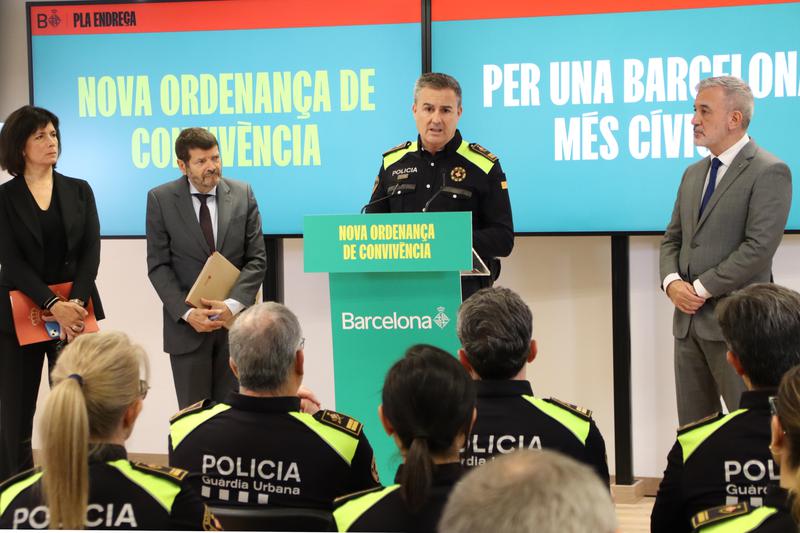

Barcelona's updated Civic Ordinance officially came into force on Sunday, February 15, introducing tougher fines, new aggravating factors, and faster enforcement mechanisms.
Here is what residents and visitors need to know:
- Urinating in the street – fines of up to €750
- Failing to dilute your dog’s urine – fines of up to €300
- Drinking alcohol in restricted areas or in the presence of minors – fines up to €1,500
- Serious noise violations – fines up to €3,000
- Graffiti offenders will not only face fines but also have to cover cleaning and repair costs
City officials say updated ordinance aims to restore order and strengthen residents' sense of safety.
Barcelona deploys police operations across districts as one in four emergency incidents handled by the city's local police force, Guàrdia Urbana, relates to public order and coexistence.
Mayor Jaume Collboni, joined by Deputy Mayor Albert Batlle, Commissioner for Coexistence Montserrat Surroca, and Chief Superintendent Pedro Velázquez of the Guàrdia Urbana, outlined the new measures on Monday morning, framing the reform as both a public order and public perception strategy.
According to the latest municipal data, acts such as nighttime noise, public drinking, vandalism, and littering are making residents' perceptions of insecurity, even as crime trends fluctuate, worse.
A municipal survey taken in June 2025 shows that while insecurity is no longer considered the city's top concern, eight out of ten residents still view incivility as a serious or very serious problem.
"Civility is not only a legal obligation, it is an attitude that reflects how we respect one another," Collboni said.
Citywide police deployment
To put the new rules into practice, the local police has launched a citywide operation combining uniformed and plainclothes patrols in squares, streets, and parks identified as high-incidence areas.
Officials say the goal is not only to penalize but also to prevent repeat offenses through a combination of enforcement and outreach.
Priority areas for intervention include: public alcohol consumption and so-called "botellón" gatherings, graffiti and vandalism, public urination and littering, conduct affecting sexual freedom and personal dignity, and damage to urban infrastructure.
Updated fines and new aggravating factors
The updated ordinance raises some fines and introduces mechanisms to streamline enforcement, particularly for non-residents, with the aim of reducing what officials describe as a sense of impunity.
City leaders stress that the reform also includes preventive campaigns and alternatives to fines in cases involving social vulnerability, reflecting an effort to balance enforcement with social support.
100,000+ complaints last year
In 2024, Barcelona recorded 100,258 complaints under the Civic Ordinance.
Among the most frequently reported infractions, unauthorized street vending accounted for 47.66% of complaints, nearly 80% of which involved abandoned materials.
Public alcohol consumption represented 35.54%, noise pollution made up 7.36%, and public urination accounted for 5.81%.
The council has also created a monitoring commission that will review impact indicators, operational data, and feedback from neighborhoods to adjust priority locations, time slots, and protocols if necessary.