Catalan startup adapts dragon fruit to be grown in Catalonia
Pitaies Catalanes say the crop could help farmers diversify as temperatures rise
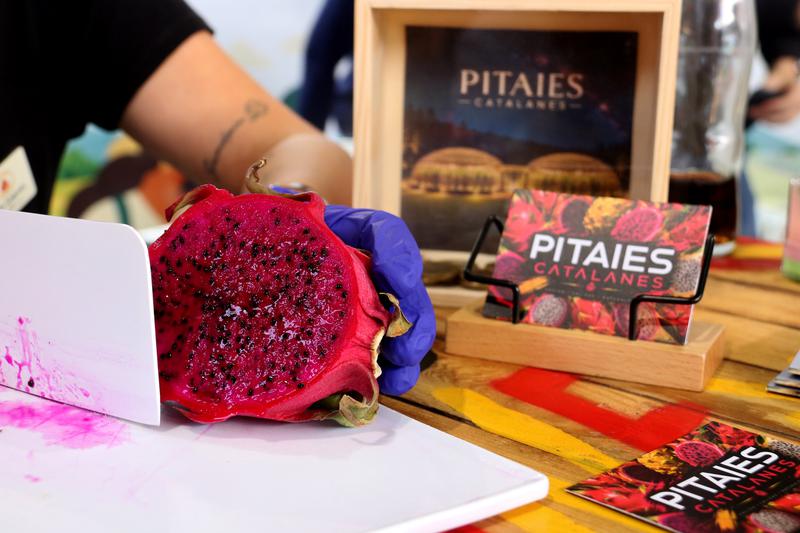

Pitaies Catalanes, an emerging startup, aims to expand the sustainable cultivation of pitaya, or dragon fruit, in Catalonia.
The business is taking part in Emprèn Agro Bio, an acceleration program in Lleida that supports agri-food, bioeconomy and agricultural production initiatives. Based in Valls, the company has adapted varieties of the tropical fruit, native to Central America and Mexico, to the Catalan climate.
They can be grown outdoors or indoors in greenhouses designed to simulate tropical conditions. Aida Aragonès, one of the project's founders, said she believes growing the fruit in the Lleida area could help diversify agriculture as temperatures rise.

For more than eight years, the team has worked with a genetic bank of dragon fruit varieties from Mexico, China, Vietnam, Central America and South Africa, aiming to adapt them to the Mediterranean climate.
"We have developed varieties that are large in size, vibrant in color and sweet in taste," Aragonès said. She added that the team has also created self-pollinating varieties as well as a greenhouse that mimics a tropical climate, allowing for a harvest season of 10 months a year.
"It uses a 'rain effect' and specialized lighting, all without the need for air conditioning or heating," Aragonès said.
The team currently grows 3.5 hectares (about 8.6 acres) of dragon fruit, 3 hectares indoors and half a hectare outdoors, on land in Alt Camp county.
Pitaies Catalanes sells fruit directly to consumers and offers cuttings, nursery stock and turnkey greenhouse solutions within Catalonia. The company plans to expand to the rest of Spain, as well as to France, Italy and the Netherlands.

A versatile fruit with 'minimal' production costs
Aragonès said monthly cultivation costs are "very low," roughly 2% of profits. The crop also requires no phytosanitary products, such as pesticides or fungicides, and sells for around €5 per kilogram.
Additionally, it has other uses beyond food.
"Because of the dye released by red-fleshed pitaya, cosmetic companies are testing it as an alternative to traditional carmine," she said.
The proposal is attracting interest from greenhouse owners, who see the effect climate change and rising temperatures have on their crops.
As a result, farmers view dragon fruit as a viable alternative for transitioning their production. Aragonès also said the team is experimenting with intercropping pitayas within orange orchards in frost-free areas.