Barcelona-led study points to advance in severe stroke recovery
Hospital Clínic trial finds adding clot-dissolving drug after thrombectomy boosts patient outcomes

A study led by Hospital Clínic Barcelona and its biomedical research institute IDIBAPS has found that adding a clot-dissolving drug after a clot-removal procedure significantly improves recovery in patients with severe ischaemic stroke.
The researchers set out to understand why, despite major advances in recent years, only around one-third of stroke patients make a full recovery within three months.
They hypothesised that reopening the main blocked artery may not be enough to restore adequate blood flow to the brain.
The findings, published in the JAMA medical journal, are expected to influence clinical practice. The study's authors described the results as "great news" for patients.
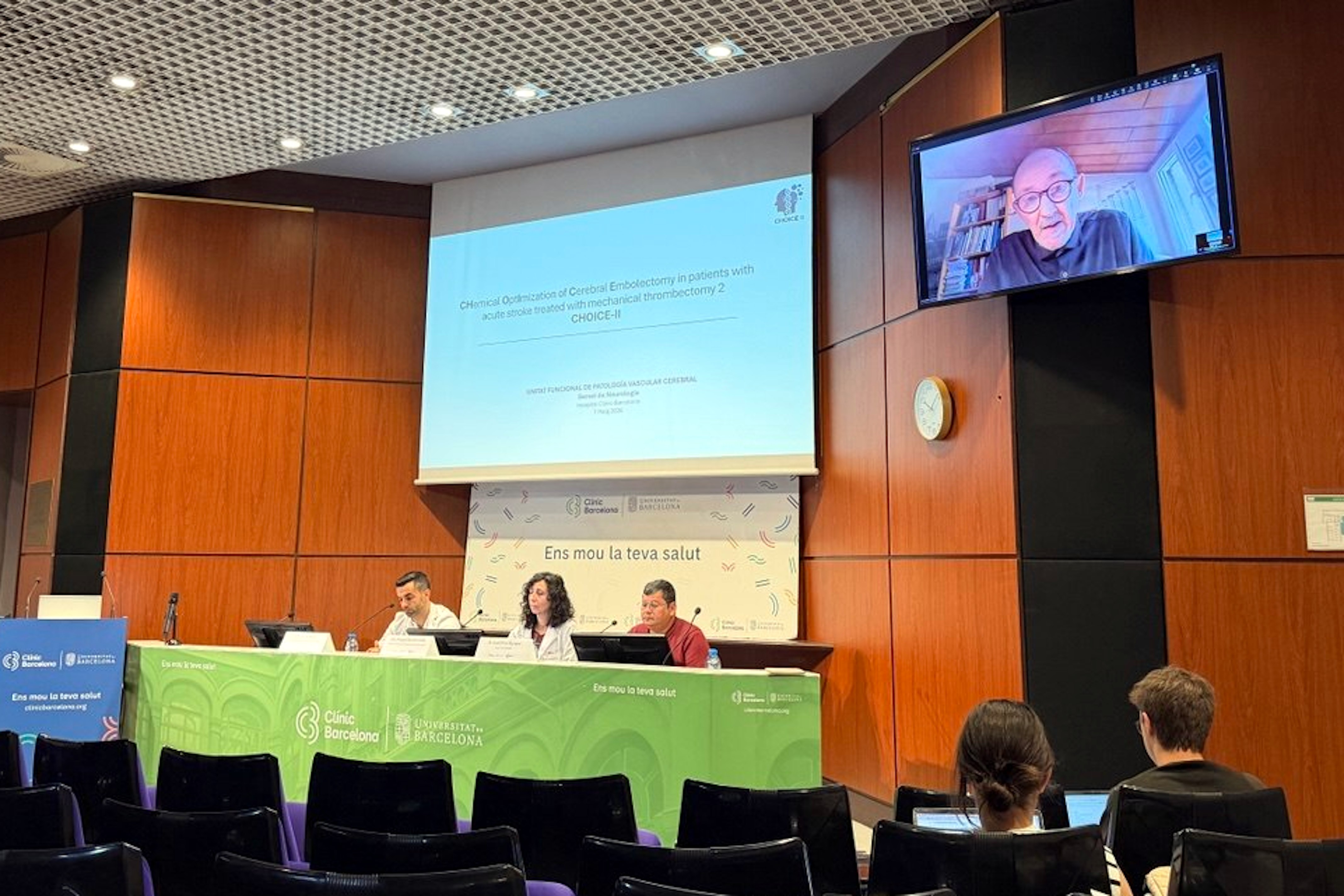
The trial, known as CHOICE-2, builds on earlier research by the same team published in 2022 and strengthens the argument that, in some patients, reopening the main artery alone is insufficient to ensure proper brain recovery.
Previous studies have shown that, even after removal of the main clot, impaired circulation can persist in the brain's smaller blood vessels, limiting neurological recovery.
"This is what we call a microcirculation problem," said Dr Ángel Chamorro, the study coordinator.
"It is as if we reopen a motorway, but some secondary roads remain blocked. If blood does not properly reach the brain tissue, the brain cannot fully recover."
That observation formed the basis of the original CHOICE study, published in JAMA in 2022, which suggested that adding drug treatment after thrombectomy could improve fine circulation within the brain. The CHOICE-2 trial has now confirmed that hypothesis with a larger sample.
The study involved 440 adults with severe ischaemic stroke treated at 14 specialist hospitals across Spain.
The results showed that patients receiving the combined treatment strategy achieved better outcomes. Ninety days after their stroke, 57.5% of patients who received the additional drug treatment had made a very good functional recovery – with no disability or only minimal symptoms – compared with 42.5% of patients treated with thrombectomy alone.
Imaging tests also showed that these patients had fewer areas of the brain with insufficient circulation, a key factor in neurological recovery.
"Improving circulation in the brain's smallest blood vessels can make a significant difference to the patient's recovery," said Dr Arturo Renú, the paper’s lead author.