Authorities urge calm after Shamonda virus found on three Girona cattle farms
Farmers call for for new protocol, while minister says virus poses no danger to humans
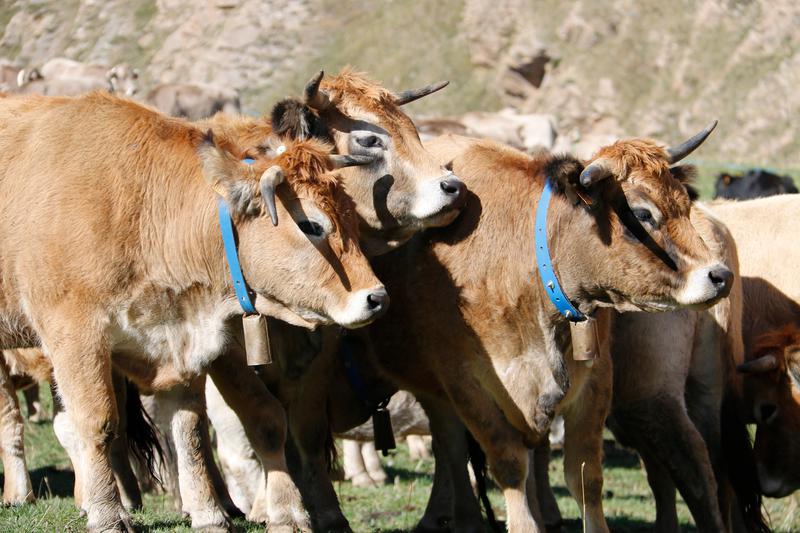

Catalonia's Agriculture Minister Òscar Ordeig called for "calm and reassurance" after the Shamonda virus, which infects cows, was detected at three farms in the Girona area.
Ordeig said "all the experts" have confirmed it is not a zoonotic disease, meaning one that spreads from animals to people, and that there is no evidence of animal-to-animal transmission.
This comes despite the fact that France confirmed a first-ever known human case of the virus, detected in a patient who died this October.
The minister said there is "no danger" in eating meat or drinking milk and praised how quickly the disease was detected on Catalan farms.
When asked about the death of the French citizen, Ordeig said "an investigation is underway" and urged "caution."
"The cause of this person's death is not yet clear," he said.
"We have very modern, professional farms that operate to a very high standard," Ordeig said. "There is no need for culling or vaccination, and the animals recover from the illness within a week."
Ordeig acknowledged that the virus needs further research as it is "new" to Catalonia's livestock, but he stressed there is no risk in consuming meat or milk.
"All the scientific evidence in the world, and the leading experts on this subject, tell us there is no need to worry," Ordeig said. "That is why I am calling for calm, everyone should continue with their usual activities, and we should let the scientists do their work."
Ordeig said the department's duty is to "be transparent and take responsibility" and he called the detection of the virus "rapid." "It is transmitted by mosquitoes, so the incidence will decline as we head into winter," he said.
Farmers' union calls for a new protocol
Unió de Pagesos, a Catalan farmers' union, called for a "specific action and monitoring protocol" for the Shamonda virus, which isn't on the European Union's list of regulated animal diseases.
The union argues that protocols must be adapted because climate change is helping insects spread diseases.
It said the spread of other animal diseases, such as bluetongue and lumpy skin disease, "highlights the need to adapt health policies to a reality where these diseases can reach areas where they were previously uncommon."
The union said affected cattle farms may see a 10% to 20% drop in milk production for about two weeks, followed by a gradual recovery. It also expects reproductive problems on affected farms, including fertility problems and miscarriages.
Unió de Pagesos called current European policies "obsolete and overly restrictive," saying they don't provide effective management tools, and asked for "greater agility from the authorities to ensure that bureaucracy does not delay the updating of protocols."
It said communications from Spain's Agriculture Ministry "arrived late" and that it is in "constant contact" with the Catalan Department of Agriculture to "closely monitor the situation in Catalonia."
"This virus has been circulating globally for 60 years," said Jordi Cros, head of the union's dairy cattle division. He also said European bureaucratic processes must be "streamlined" immediately to adapt to "current realities."