Authorities say no indication yet found that African swine fever outbreak originated in Catalan research lab
Agriculture minister says 26 positive cases found among 360 wild boars analyzed
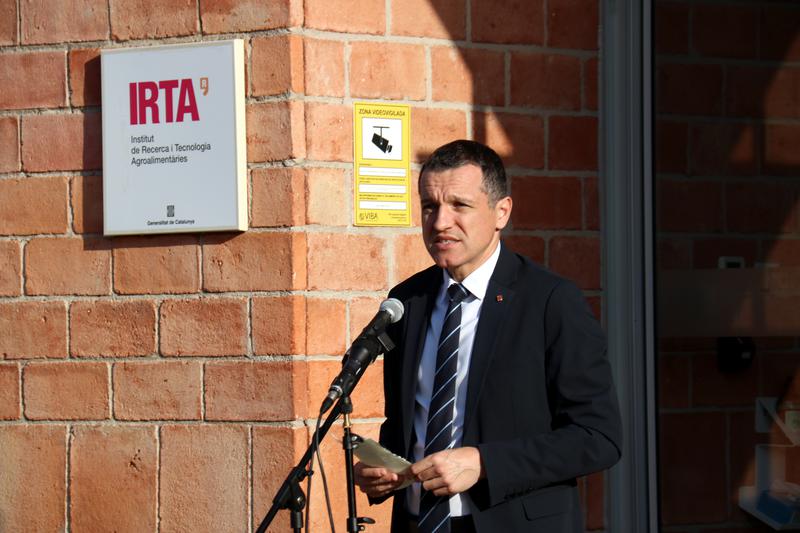

Catalonia's Agriculture Minister, Òscar Ordeig, has explained that experts from the European Commission and the Ministry of Agriculture have not yet found "any indication" that the origin of the African swine fever (ASF) outbreak came from the Animal Health Research Center (IRTA-CReSA).
In a media briefing from the laboratory, the minister explained that the government's audit indicates that "everything has been done correctly" in the laboratory, which is located near the location where the first positive wild boars were found.
On Thursday, police raided the research lab for 14 hours, aiming to determine whether the outbreak started in the lab.
A total of 360 wild boars in the infected area have been analyzed, of which 26 are positive and one is suspicious, giving a rate of 7% of positives, a figure that "is decreasing every day", according to Ordeig on Friday.
Report from European experts
According to the Department of Agriculture, the preliminary report of the European Commission expert committee concludes that “no obvious route has been identified” by which the virus could have left the IRTA CReSA facilities.
It also points out that the facilities are adequate and that the professionals do their job well.
Specifically, it says that the laboratory has demonstrated “a high level of technical competence and professionalism” and that the biosecurity measures are “appropriate.”
“The center is aware of the risks and has clear procedures to identify and manage critical points”, it highlights. It also says that there are “exhaustive” records of the use of the virus, animal experiments and incidents.
The minister called for “prudence” and to let scientists do their work before determining whether there has been a leak of the virus. He also praised the lab as a benchmark in the treatment of the disease, “one of the five best in Europe and the best in Spain.”
The minister said the virus must be sequenced "as quickly as possible" to be able to rule out whether or not the strain found in the dead wild boars coincides with any of the 28 that are used for experiments at the center.
He explained that there are three underway, one of which by the Institute for Biomedical Research (IRB).
Sequencing usually takes between seven and ten days, but Secretary General of Agriculture, Cristina Massot, wanted to be cautious about publishing the results, as dozens of samples are being analyzed.