Spanish government and Catholic Church seal deal to compensate abuse victims
New protocol lets victims file claims from April 15, with ombudsman holding final say on reparations
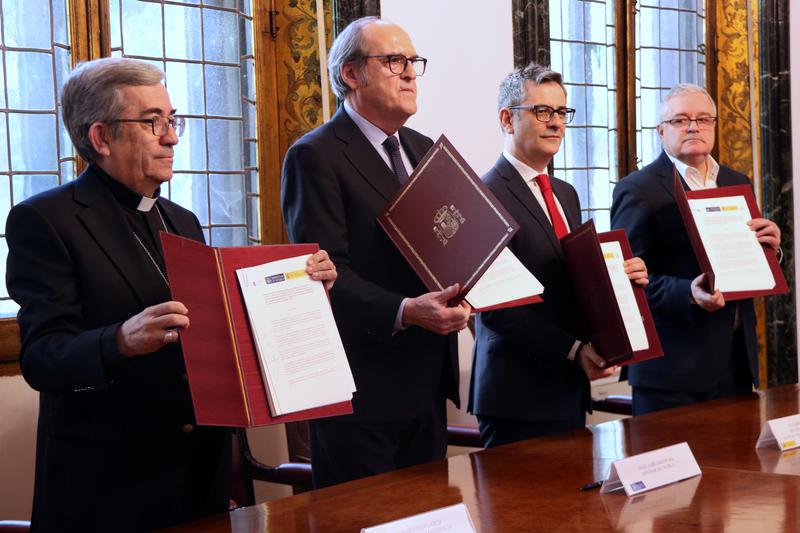

Spain's Catholic Church and the national government signed an agreement this Monday to launch a new system to compensate victims of sexual abuse within the Church, months after first announcing the agreement in January.
The deal, signed by the Spanish Bishops' Conference, the Conference of Religious, the government, and the ombudsman, establishes a protocol allowing victims to seek reparations even if they have already pursued other avenues, such as the Church's previous Comprehensive Plan for the Reparation of Abuse Victims (PRIVA) system, its internal compensation program.
The framework sets no minimum or maximum compensation amounts, leaving final decisions to the ombudsman.
"The request for forgiveness is meaningless without a commitment to make amends," said Bishops' Conference president Luis Argüello as he presented the plan.
The agreement was formally signed by Argüello, Spanish presidency minister Félix Bolaños, and Ombudsman Ángel Gabilondo.
The new system gives a central role to the ombudsman in handling cases that are no longer subject to legal action due to statutes of limitations or the death of the alleged perpetrator.
Separate from the courts, the protocol allows for both symbolic and material reparations.
These may include institutional recognition, formal apologies, psychological and medical support, and financial compensation covering harm suffered, as well as treatment costs and lasting physical or psychological effects.
The mechanism will initially run for one year starting April 15, with the possibility of a 12-month extension.
Under the agreement, the presidency minister will set up a processing unit to receive claims and guide victims.
Meanwhile, the ombudsman's office will create a dedicated victims' unit staffed by independent experts to assess each case and propose appropriate reparations.
The Church, through the Bishops' Conference and religious orders, will issue detailed reports on each claim.
A joint commission made up of representatives from all signatory bodies and victims' associations will seek consensus when there is disagreement between the Church and the ombudsman's assessment.
Bolaños described the agreement as a step forward for "thousands of victims" who previously lacked support or were even questioned. "Each case will be examined in depth, and each one is different," he said.
If no agreement is reached, Bolaños stressed, "the final word belongs to the state," specifically, the ombudsman, regarding compensation.
He added that the framework has the Vatican's backing and was discussed with Pope Francis during the Spanish king and queen's recent visit to the Holy See.
Argüello said the model reflects a genuine effort by the Church to make amends, acknowledging that some victims have not felt they could trust dioceses or religious institutions in the past. "Forgiveness requires concrete acts of reparation," he said.