Fiscal and Financial Policy Council greenlights new financing model
Proposal passes with support from Canaries and Catalonia, as conservatives reject "unsolidarity" plan
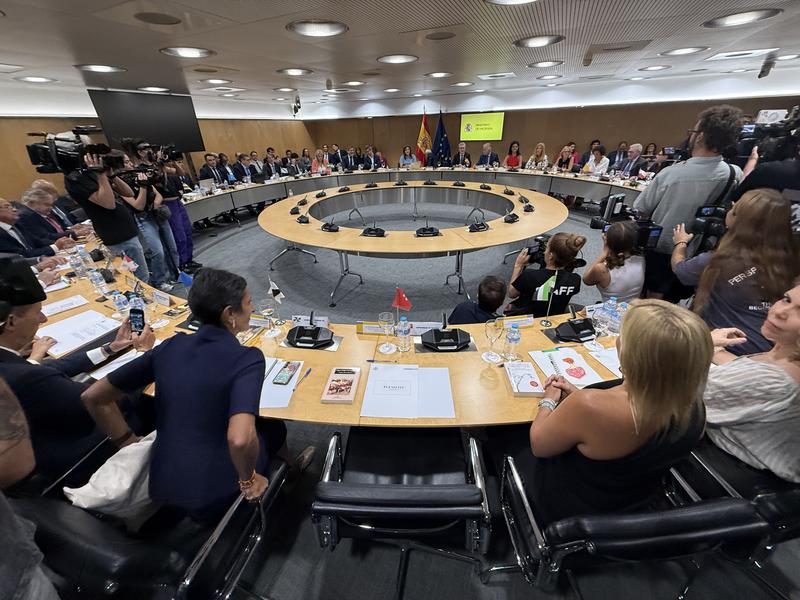

The Fiscal and Financial Policy Council has given the green light on Friday to the new financing model.
The proposal passed with the support of Catalonia and the Canary Islands.
The new fiscal model will mean an additional €4.686 billion into the coffers of Catalonia, one of the highest figures of the entire distribution.
Castilla-La Mancha and Asturias, the regions governed by the conversative People's Party who attended the meeting despite the attempts from the Madrid region to boycott it, voted 'no', calling it "unsolidarity."
Having passed Friday's procedure, the proposed model can continue its path to the Council of Ministers, which will approve it as a preliminary draft of an organic law, before going on to the Congress of Deputies.
The Ministry of Finance estimates that they will need between 10 and 12 days to translate the proposal into text and approve it at government headquarters.
Catalonia's Minister for Economy and Finance, Alícia Romero, expressed "absolute satisfaction" with the approval of the new model. "Today an important path begins," she said.
Regions controlled by the PP unanimously criticized the new system. According to the Andalusian minister, Carolina España Reina, the model "breaks the equality" of the territories to give "privileges to Catalonia" and has been "designed by the independence movement."
New financing model
The new model will allow autonomous regions to increase the percentage of taxes they collect.
The transfer of personal income tax will increase from 50% to 55%, and that of VAT from 50% to 56.5%.
Other notable changes include modifications to the adjusted population criteria, leveling mechanisms, and compensation between territories.
The model also modifies the so-called "adjusted population," the mechanism that attempts to determine how much resources each territory needs to provide public services, based not only on the number of inhabitants, but also on their characteristics.
The system also incorporates a 'status quo' clause so that no autonomous community receives fewer resources than under the current model.
Solidarity mechanisms are also axed. The so-called horizontal leveling will guarantee that all communities reach at least 75% of the average adjusted resources per inhabitant derived from their tax capacity.
At the same time, the state will contribute €19 billion through the so-called vertical leveling to reduce by two-thirds the distance of each community with respect to the one with the most adjusted resources per inhabitant.
The new model also gives communities the option of receiving a portion of the VAT generated by small and medium-sized enterprises established in their territory.
Voluntary application
The Treasury's approach also includes a clause that will allow each community to decide whether to adopt the new system or remain with the current one, a formula that was already employed when the 2009 model was approved.
In this way, a community that politically rejects the reform is not automatically obliged to apply it if it considers that the current system is more favorable.