Congress rejects Vox's burqa ban bill as Junts files alternative
Spanish government open to "rigorous" debate while Catalan executive calls for calm and rejects "political opportunism"
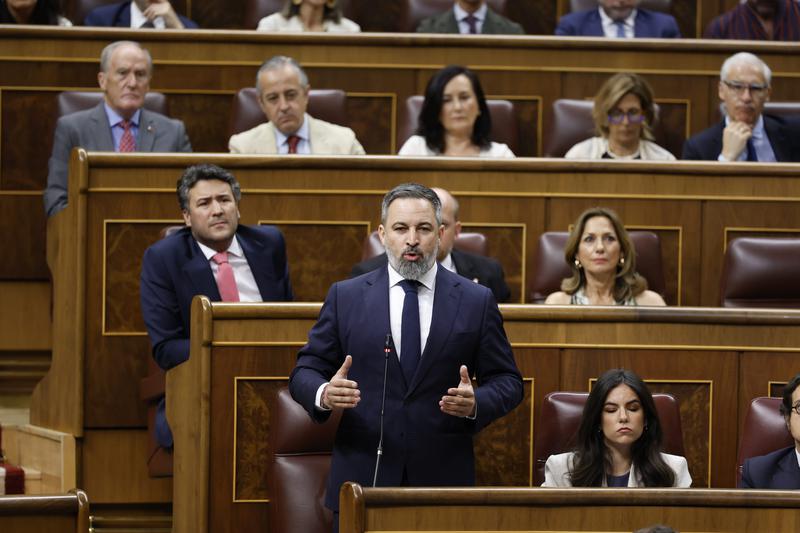

Spain's Congress of Deputies rejected a bill from Vox on Tuesday to ban the burqa, a full-body veil that covers the face and eyes, and the niqab, which covers the face but leaves the eyes visible, in public spaces.
The Catalan pro-independence party, Junts, voted against the proposal and registered its own alternative initiative.
The bill from far-right Vox, backed by the conservative People's Party (PP), was defeated by 177 votes to 170, with one abstention.
Junts' 'no' vote proved decisive in blocking the measure, despite the party sharing the objective of restricting full-face veils in public spaces.
Two different approaches
Vox's proposal sought a general ban on the burqa and niqab in public areas and in private spaces with public exposure.
According to the party the garments undermine women's dignity and pose security risks.
The text included sanctions, potential prison sentences for those who impose the garments, and even the possibility of expulsion from Spain in cases of serious or repeat offenses.
Junts rejected Vox's initiative, arguing it would not pass "any European filter."
However, the party registered its own proposal to prohibit burqa and niqab on the same day.
Unlike Vox's text, Junts' proposal does not establish a specific system of fines.
Instead, it relies on possible sanctions through disobedience laws and avoids criminalizing women who may be forced to wear the garments.
The party describes its bill as legally aligned with European standards and limited to a single-article regulation focused on identification.
Junts has expressed hope that the Socialist Party will back its proposal without the need for negotiations.
Constitutional concerns and political tensions
Second Deputy Prime Minister Yolanda Díaz warned that banning the burqa in public spaces could violate Spain's Constitution.
She cited protections against discrimination and guarantees of religious freedom.
During the debate in Congress, Vox leader Santiago Abascal accused Catalan pro-independence parties of prioritizing what he called an "Islamic republic" over women's freedom.
The far-right party framed the ban as a matter of identity, immigration, and public security.
Catalan government calls for "rigorous" debate
The Catalan government says it is willing to open a debate on the use of the burqa, but only under what it described as calm and rigorous conditions.
Government spokesperson and Minister of Territory Sílvia Paneque said the issue "generates social unease" and therefore "must be addressed."
However, she stressed that any discussion should take place away from "political opportunism" and confrontation.
Paneque suggested that the current proposals, both from Vox and Junts, appear more driven by political positioning than by a genuine effort to foster a serious debate.
Meanwhile, in an interview with RTVE, Barcelona Mayor Jaume Collboni said he does not like the burqa, calling it a way of "denying a woman's identity."
He argued that its use in public spaces should be regulated but cautioned that an outright ban "wouldn't achieve the goal" of letting women freely choose how to dress.
"It's a debate that must be addressed," Collboni added.