Spain and Catholic Church sign agreement to compensate victims of sexual abuse
Ombudsman to oversee redress process, including possible financial compensation, for cases where criminal prosecution is no longer possible
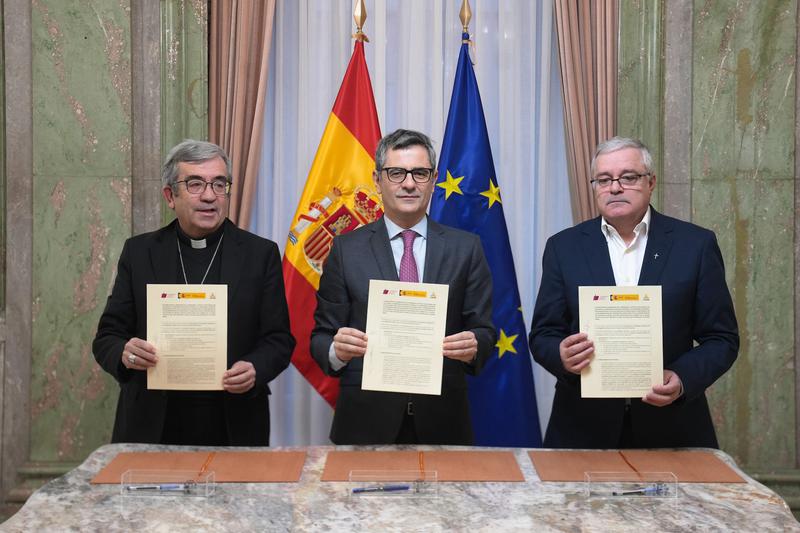

The Spanish government and the Catholic Church signed an agreement on Thursday to provide compensation and formal recognition to victims of sexual abuse whose cases can no longer be pursued through the courts.
The deal establishes a joint Church–state system of redress, with the participation of victims, aimed at cases that have expired under the statute of limitations.
It was signed in Madrid by the minister for justice, Félix Bolaños, alongside the president of the Spanish Episcopal Conference (CEE), Luis Argüello, and the president of the Spanish Conference of Religious Orders (Confer), Jesús Díaz.
In a press conference following the signing, Bolaños singled out the tireless work of victims' associations in fighting "silence and inaction," as well as the Vatican's involvement and support at key moments.
He celebrated the fact that the agreement fully adheres to the recommendations of the Ombudsman after "arduous, complex, tough, and lengthy" talks.
Bolaños said the deal for "just" reparations settles a "historic moral debt" to victims of abuse within the Church.
"After decades of silence, concealment, and inaction, when victims faced walls of misunderstanding and, at times, cover-ups, today we can say that democracy is fulfilling its obligations to abuse survivors," he said.
Acknowledging that Spain may have acted late, Bolaños emphasized that victims of historic abuse until now "had nothing," as they could not seek justice through the courts.
Under the new deal, however, reparations can be applied retroactively. "This agreement allows us to grant them the right to fair and adequate compensation from the Church," he added.
Reparation process
Under the agreement, victims will begin the process by submitting their case to the justice ministry. The case will then be referred to the victims' unit of Spain's ombudsman (Defensor del Pueblo), which will be responsible for drawing up a proposed resolution or form of redress based on the victim's request.
The proposed measures may be symbolic, restorative, spiritual, or financial in nature. The ombudsman's proposal will be forwarded to an advisory commission set up by the Church under its Comprehensive Plan for the Reparation of Abuse Victims (CPRIVA), which will assess the recommendation and issue an opinion.
If both the advisory commission and the victim agree, the proposal will become final. In cases of disagreement, a mixed commission, including representatives of victims' associations, will aim to seek a unanimous agreement.
If no consensus is reached, the ombudsman's victims' unit will issue a final decision.
Any financial compensation awarded under the scheme will be paid by the Catholic Church.
According to the justice ministry, the Church will be required to implement the agreed reparations within set deadlines. If the responsible diocese, religious institute or entity fails to do so, the Episcopal Conference and Confer will step in to guarantee compliance.
The signing of the agreement comes more than a year and a half after the Spanish government approved, in April 2024, a plan to implement the findings of a landmark report by the ombudsman on sexual abuse within the Catholic Church.
That report prompted negotiations with Church authorities to create a specific redress mechanism for victims unable to seek justice through the courts because their cases had expired.