‘Déu-n’hi-do’, ‘badar, and ‘biaix’: most-searched words on Diccionari.cat revealed
Website has 7 million annual visits, while another online language pioneer Enciclopèdia.cat gets 2.5 million
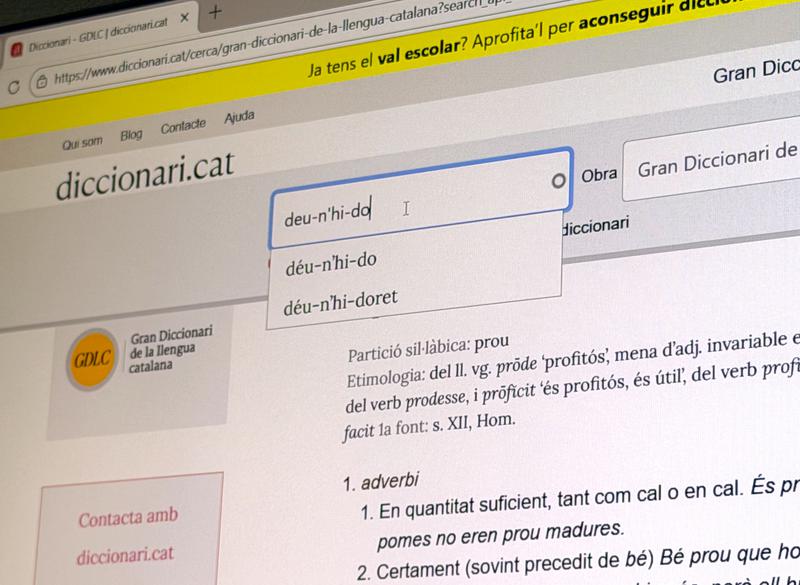

There's a commonly heard expression in Catalan that means to convey that the speaker is impressed with the magnitude, quantity, or even quality of a something observed: ‘Déu-n’hi-do’.
The remark can also be offered in a negative sense, and, in truth, its meaning almost entirely depends on tone and context.
With two hyphens, one accented letter, and an apostrophe in the middle of the phrase, its correct spelling is even tricky for Catalans themselves, let alone anybody coming at the language from an Anglo perspective.
As such, the phrase is right up at the top of the list of consulted terms on Diccionari.cat, a Catalan-language online dictionary.
Diccionari.cat was founded in 1998 and today is accessed by 7 million users each year.
Spelling, uncommon terms, and “trending” words continuously drive people to the service that today faces more “competition” than ever, including artificial intelligence.
AI has slightly reduced the volume of queries, but it also “uses” Diccionari.cat, and cites the source in its answers.
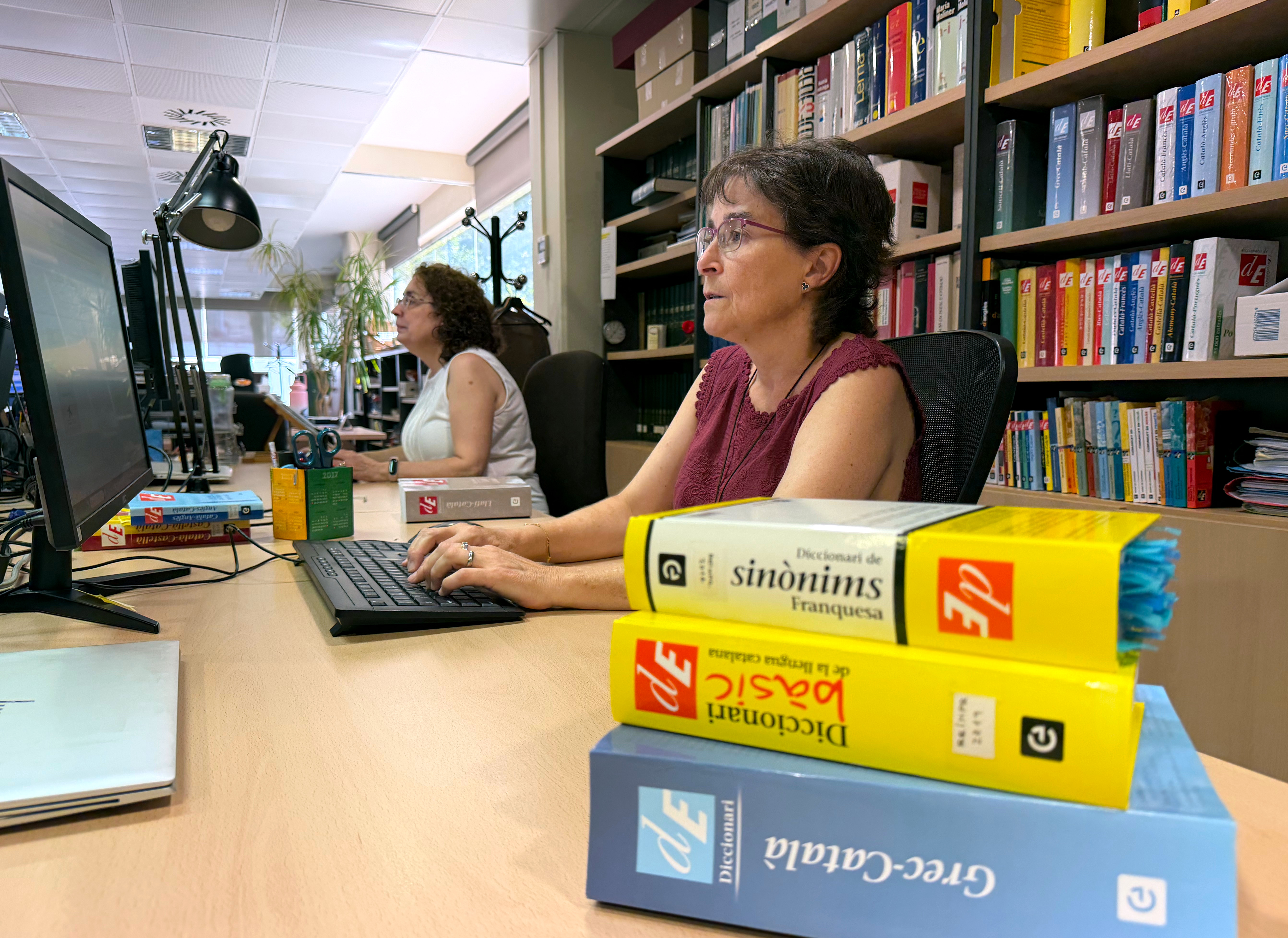
In turn, encyclopedic service Enciclopèdia.cat keeps the legacy of the physical edition alive with 2.5 million annual queries and a permanent update of the contents.
Núria Bord, head of dictionary editing at Enciclopèdia Catalana, details that the most searched terms from 2025 and in 2026 so far are 'déu-n’hi-do', 'señal', 'análisis', 'compte', 'provar', 'comptar', 'badar', 'corrent', 'biaix', and 'il·lusió'.
“No significant evolution is detected, except for the word bias, which was not consulted as much years ago, probably due to the increasing frequency of talk about gender bias or AI bias,” she tells the Catalan News Agency.
Looking at the list, it is easy to detect four types of queries: words that have difficult spelling (Déu-n’hi-do); those that pose grammatical difficulties (“un anàlisi or una anàlisi); those which have seen its use increase recently ('biaix', meaning 'bias'); and finally those that students find in academic or literary texts and that are not part of their usual vocabulary (such as 'basarda', 'feréstec', 'badoc', and 'baliga-balaga').
The success of this open and free service does not have a single reason, according to Bord. “There are many people who consult because they feel unsure about the language," either because they are learning it or that they're unsure of spelling and grammar specifics.
Bord also points out consultation “out of curiosity, even to play language games,” and obviously the consultations of students and language professionals, journalists, etc.
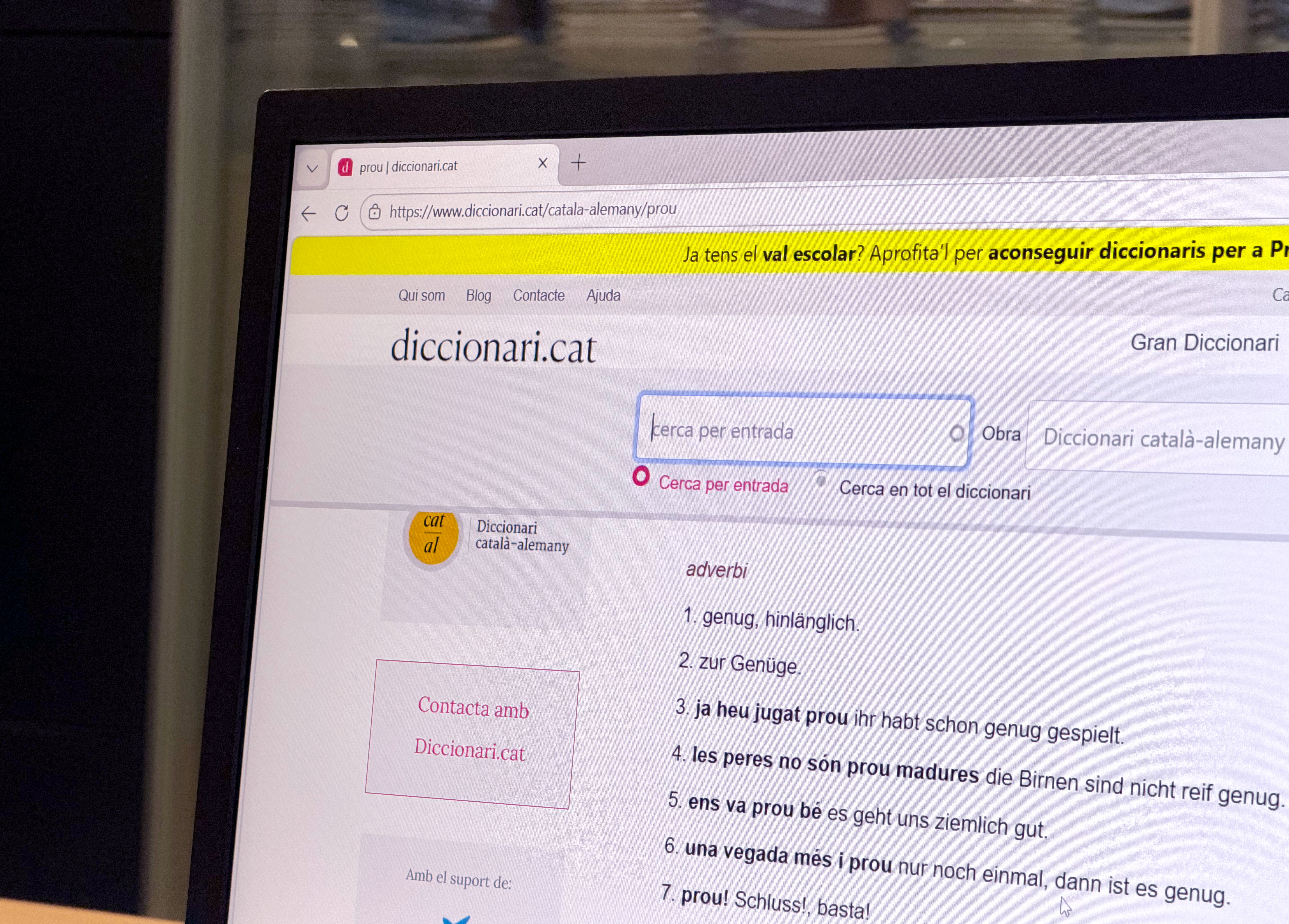
AI, competitor and user
Bord says that 7 million annual visits are “a lot,” taking into account how information is accessed today in the digital field and the great competition that exists in this environment, including AI.
However, she celebrates the fact that AI tools use the dictionaries of Diccionari.cat when preparing answers to linguistic consultations, which is easily verifiable because they cite, and often link, their sources.
Encyclopedia
In the case of the Enciclopèdia.cat service, where the objective of the search is more of content and not so much of meaning, the History of Catalonia comes out on top, with articles dedicated to Jaume I, the Reapers’ War and the Catalan-Aragonese crown.
Articles on the humanities, such as the Floral Games of Barcelona and the Renaissance are also popular, as are science, geography, or even general interest, with the ‘zodiac sign’ in first position in that category.
The person in charge of Enciclopèdia.cat and Divulcat.cat, Marga Prades, underlines the fact that this is a “living encyclopedia,” that is, that historical articles continue to be updated “based on current events.”
As they do at Diccionari.cat, a team is in charge of permanently revising and editing the content.
For both websites, the role of users is “important” and highly valued. Users can send queries and comments on the articles through separate forms.